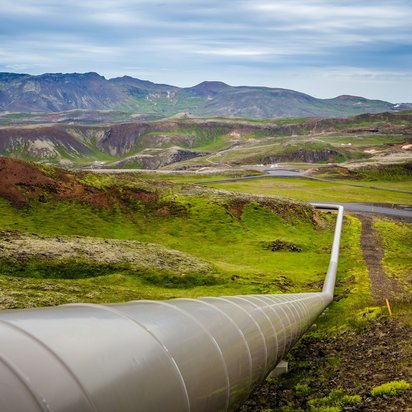
Ready for CO₂ storage and transport: Following approval by the German Bundesrat at the end of last year, the amendment to the Carbon Dioxide Storage and Transport Act (KSpTG) has come into force. The amendment creates a new framework for dealing with difficult-to-avoid and unavoidable CO₂ emissions from industry, for example in cement or lime production. It paves the way for technologies for CO₂ capture, the further use of CO₂ and geological storage.
“This sets the course for a sustainable national CO₂ infrastructure,” analyses Silvio Konrad, Chief Operating Officer of the Energy & Resources Business Unit at TÜV NORD GROUP. “It is now crucial to quickly clarify ambiguities in the law – for example, in the definition of 'difficult to' or 'unavoidable' emissions. Otherwise, a lack of clarity will lead to delays in approvals and hamper the necessary ramp-up of technology.”
What is new – and what still needs to happen?
Commercial storage: The revised KSpTG enables the commercial operation of CO₂ storage facilities for the first time. In addition to offshore storage in the Exclusive Economic Zone and on the continental shelf, federal states can also approve onshore storage facilities (opt-in).
Overriding public interest: The storage and transport of CO2 are defined as ‘projects of overriding public interest’; CO2 transport pipelines are classified as energy infrastructure – comparable to power lines. “These and other measures in the amendment will significantly speed up planning and approval procedures for the necessary infrastructure,” expects Silvio Konrad. However, apart from pipeline transport, other transport options such as ship, rail or tankers have not yet been taken into account. “These multimodal transport options must be regulated, because not all emitters will be able to connect to pipelines at the outset.”
Liability and responsibility: The law clarifies the liability for CCS facilities: initially, operators are responsible for operation, monitoring and aftercare, with the state taking over later. Aftercare, monitoring and provisions are now defined more specifically, ensuring greater legal certainty. “However, greater transparency and obligations on the part of operators, even after the transfer to the state, would be welcome in order to ensure the long-term safety of the facilities,” says Konrad.
CO₂ composition: The revision of the KSpTG specifies which ‘CO₂ qualities’ may be transported and fed into storage facilities, namely only ‘suitable, processed CO₂’. Adjustments to hazardous substances and waste legislation are planned in order to create legal transparency and ensure compliance with environmental regulations.
Transparency: Public participation remains mandatory, but is to be digitised to a greater extent and made more efficient. “We support the planned introduction of a central CO₂ storage and transport database to increase transparency and efficiency,” says Silvio Konrad.
Relationship to EU law: The new law aligns the rules on CO₂ storage and utilisation with EU requirements, in particular the CCS Directive and the 2045 climate targets. In addition, processes that remove CO₂ directly from the air are also being promoted for the first time. “Harmonisation with applicable EU law and rapid national implementation are important in order to create investment security and incentives and thus keep pace with the growing international carbon management economy,” emphasises Silvio Konrad.
Activation of the carbon management market
“The revised KSpTG is rightly regarded as a central building block for enabling the required technology ramp-up and activating the national carbon management market. However, binding timetables for setting up the necessary infrastructure and introducing uniform safety standards are now particularly important in order not to jeopardise the lengthy technology ramp-up,” says TÜV NORD energy expert Silvio Konrad.
The TÜV NORD GROUP is actively involved in carbon management:
- Expertise in the safe, efficient and sustainable use of CCS and CCU technologies
- Support in the development of a certification framework for CO₂ capture measures and the establishment of monitoring systems
- Support for the use of funding programmes
- Support for the planning and approval of CCS infrastructure, including the integration of carbon dioxide
pipelines and ancillary facilities in planning approval procedures - Legal certainty by providing support with hazardous substances and waste legislation
- Digitisation and acceleration of public participation
- Support in the introduction of a central CO₂ storage and transport database
- Support in the development of CO₂ transport infrastructure, including the conversion of natural gas
pipelines for CO₂ transport