TÜV NORD Supports Research on the Use of Molten Salt in Nuclear Reactors
Research project at the Technical University of Munich (TUM) investigating novel molten salts for applications involving high heat fluxes
Research project at the Technical University of Munich (TUM) investigating novel molten salts for applications involving high heat fluxes
CO₂ emissions are to be reduced worldwide – and innovative nuclear technologies are expected to contribute to this goal, such as Small Modular Reactors (SMRs), whose deployment is already being planned in many countries. A particularly interesting subgroup of SMRs are Molten Salt Reactors, which use liquid salt as a coolant. In order to study the flow behavior of these molten salts more precisely, TÜV NORD is now funding a research project at the Heinz Maier-Leibnitz Research Neutron Source (FRM II) at TUM.
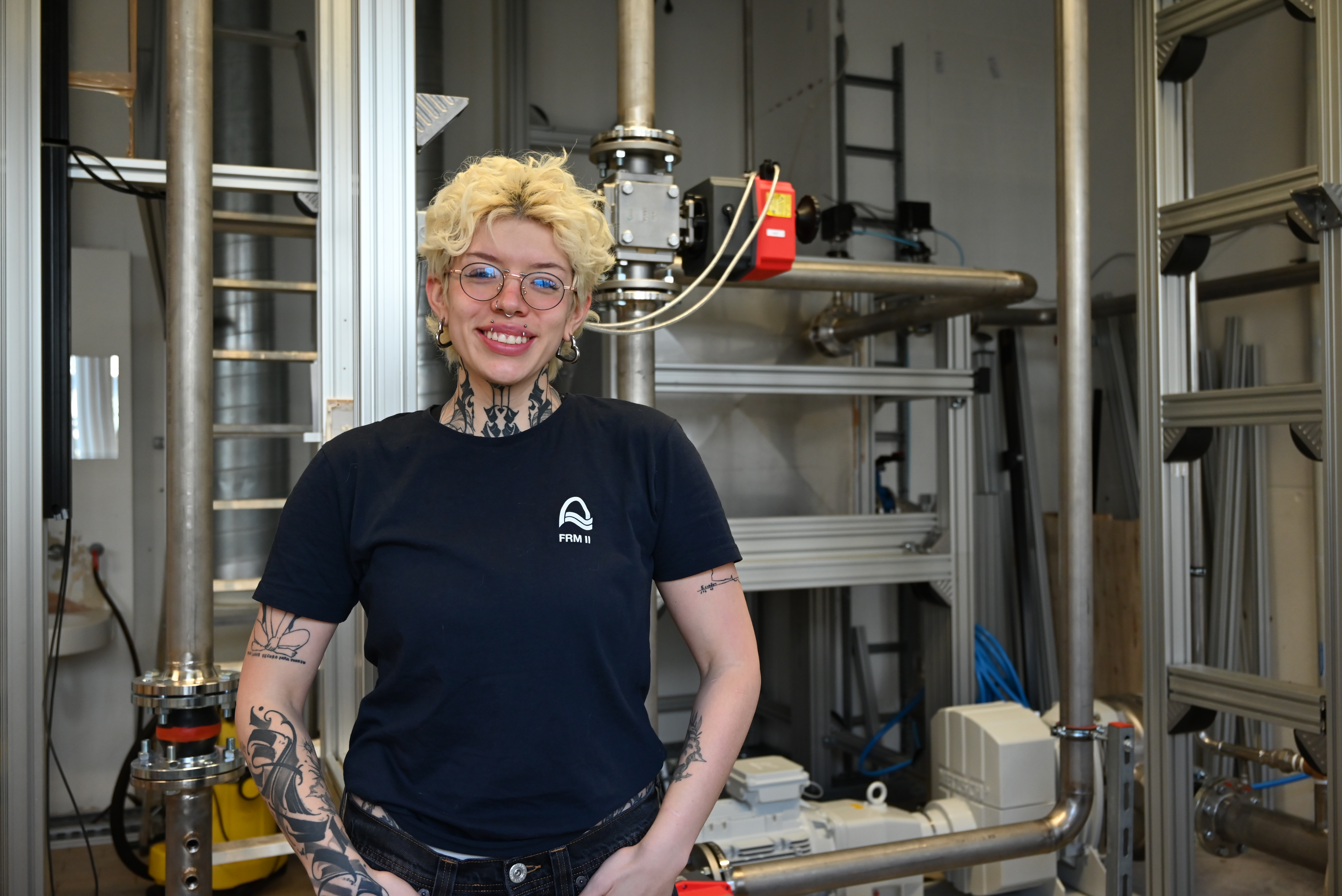
“Molten salts as heat transfer media offer great potential to make energy systems more efficient and powerful – while also being environmentally friendly and economical. By further developing these technologies, we can make an important contribution to decarbonizing the energy sector and thus to climate protection,” says Liliana Quintero Zambrano, who is conducting research as a doctoral candidate at the TUM Center for Nuclear Safety and Innovation (CNSI) at FRM II as part of the TÜV NORD–funded project.
The newly launched research project, “Investigation of Novel Molten Salts for Applications with High Heat Fluxes,” is financed by the TÜV Nord-Vereine and the RWTÜV Foundation, which are shareholders of the TÜV NORD GROUP. Technical supervision is provided by TÜV NORD EnSys as a nuclear technical expert organization.
“We are very pleased to advance the application of innovative technologies for a climate-neutral energy future through the financial support of this research project,” says Thomas Rappuhn, Chairman of the Supervisory Board of TÜV NORD AG.
“Molten salts are proving to be a promising heat transfer medium both for small reactors and for concentrated solar thermal energy. In some reactor designs, they are even used as a fuel-bearing medium,” explains Frank Meissner, Head of Reactor Technologies at TÜV NORD EnSys. “However, due to their high melting temperatures and the aggressive corrosion behavior affecting the materials used at temperatures above 550°C, the use of molten salts is highly demanding.” They are already in use today in some nuclear experimental facilities and solar thermal power plants. “For future commercial applications in Molten Salt Reactors as well as for further research, we need to understand the properties of molten salts and their flow behavior under specific thermal conditions even more precisely,” the expert adds.
The aim of the research project is to characterize different molten salts and investigate their thermohydraulic properties over a broad range up to high heat fluxes (> 400 W/cm²) and power densities (> 5 MW/l). Of particular importance in this context is the heat transfer between surfaces and the different molten salts, which will be studied in greater detail. This will make it possible to characterize the cooling capability of molten salts and potentially establish new correlations for safety analyses.
As part of the doctoral research, a thermohydraulic test facility for the use of molten salts will be set up, and a Particle Image Velocimetry (PIV) system will be used for analysis. The experimental data obtained will be simulated using Computational Fluid Dynamics (CFD) codes such as OpenFOAM, ANSYS CFX, and ANSYS Fluent, in order to advance the validation of CFD programs for applications involving high heat fluxes.
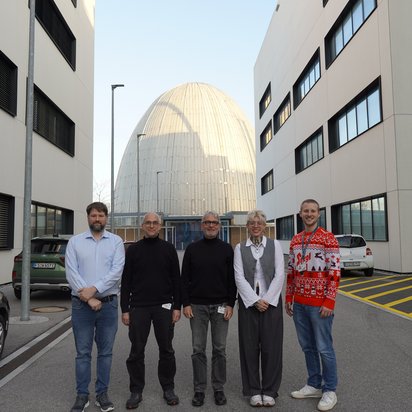
TUM and TÜV NORD are planning close collaboration among the project partners:
“Through this cooperation, we gain deep insight into the expertise of a technical inspection organization in the validation and verification of materials and computer codes for new applications. As a doctoral candidate, Liliana Quintero Zambrano is therefore working in a field that spans from development to operation and is directly engaging with the associated issues,” says Prof. Dr. Christian Reiter from the Chair of Applied Nuclear Technologies at TUM, who supervises the work.
“With this joint research project, we are expanding our expertise in a new and promising approach to heat transfer materials and reactors, as well as the associated system requirements. This means we are not only gaining a better understanding of the properties of very hot molten salts, but also of the parameters required to assess the phenomena that occur,” emphasizes Frank Meissner.
The funding period for the doctoral project provided by the TÜV Nord-Vereine and the RWTÜV Foundation is three years; the project began in October 2025.
Founded over 150 years ago, we stand for security and trust worldwide. As a knowledge company, we have our sights firmly set on the digital future. Whether engineers, IT security experts or specialists for the mobility of the future: in more than 100 countries, we ensure that our customers become even more successful in the networked world.