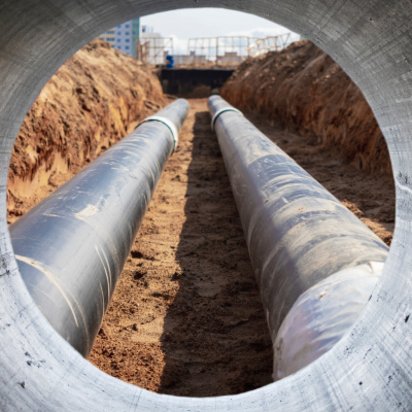
Capturing carbon dioxide is no longer just a vision for the future. Cement, lime, steel and chemical plants in Germany and across Europe are already working on the necessary facilities. However, a captured carbon dioxide molecule must then be sent somewhere: either into a final product or into an underground storage site. It is precisely at this stage, during transport, that it will be determined how quickly the so-called carbon management economy in Germany actually gains momentum. “Without a safe transport route, no investment decision can be made for any capture plant, as transport and storage together account for around 30 to 50 percent of the total costs of a carbon dioxide chain,” emphasises carbon management expert Michael Baranowski of TÜV NORD.
Why this issue is now gaining momentum
Three developments are leading to carbon capture, transport and storage (CCS) and the utilisation of CO₂ as a raw material (CCU) becoming a mandatory requirement for many industrial sectors:
With the Net-Zero Industry Act, the EU has set a binding target: by 2030, it must be possible to permanently store at least 50 million tonnes of carbon dioxide per year within the EU. 44 specifically named oil and gas companies must contribute to this in proportion to their historical production levels; this was laid down by the European Commission in May 2025.
Germany has followed suit: the amendment to the Carbon Dioxide Storage and Transport Act (KSpTG) came into force at the end of 2025. For the first time, it permits commercial carbon dioxide storage on the German continental shelf and in the Exclusive Economic Zone, and establishes a standardised authorisation procedure for transport pipelines, modelled on the planning approval legislation for natural gas pipelines.
The European Emissions Trading Scheme (EU ETS) is increasing the economic pressure: at the start of 2026, allowances for one metric tonne of carbon dioxide cost around 65 to 75 euros. “We expect this trend to continue upwards in the coming years,” says Michael Baranowski.
“These developments clearly show that, for energy-intensive industrial sectors such as cement, lime, steel, chemicals and waste incineration, CCS is thus increasingly becoming an economically viable option rather than a voluntary additional measure,” emphasises carbon dioxide expert Mr. Baranowski.
A comparison of transport routes
There is no single way to transport carbon dioxide from the capture plant to the storage site or to the user. The choice depends on the volume, distance and destination.
Pipelines are the most cost-effective solution for large, continuous volumes. Onshore pipelines transport carbon dioxide at 80 to 150 bar in a supercritical state – similar to natural gas pipelines, but technically more challenging because, when the pressure is released, carbon dioxide cools abruptly to as low as minus 78 degrees Celsius and can solidify into dry ice. The costs are around 2 to 20 euros per tonne, and 5 to 30 euros for offshore transport. However, building a comprehensive network is a project that will take one to one and a half decades: the network operator OGE is planning a core carbon dioxide network around 3,500 kilometres long, focusing on north-western Germany, and, building on this, the Association of German Cement Works (VDZ) is proposing a target network of around 4,800 kilometres for cement, lime and waste sites by 2045.
Ships transport liquefied carbon dioxide at around minus 50 degrees Celsius and 6 to 9 bar. They are more expensive (25 to 100 euros per tonne, depending on the distance), but offer the advantage of flexibility without the need to construct a fixed pipeline beforehand. The Norwegian Northern Lights project is already utilising this method commercially and, in its first phase, can handle 1.5 million tonnes of carbon dioxide per year, rising to up to 5 million tonnes from 2028.
Rail and lorries fill the gap where neither pipelines nor ships are available. Tank wagons and tanker lorries can be deployed immediately, but are limited to small quantities (under 2 million tonnes per year) and short distances – and, at 15 to 100 euros per tonne, are the most expensive option. They are particularly relevant for the material use of carbon dioxide, for example in the drinks industry, in greenhouses or in the production of e-fuels, where distances between source and consumer are short anyway and high purity requirements, in some cases exceeding 99.9 percent, apply.
Barriers to expansion
As clear as the technical options are, the obstacles to a rapid ramp-up remain significant:
From a regulatory perspective, a robust framework is still lacking, particularly with regard to the cross-border use of shipping. Although the London Protocol has, in principle, permitted the export of carbon dioxide for storage abroad since an amendment in 2009, not all EU Member States have ratified this amendment. Furthermore, bilateral agreements are still lacking for German exports to, for example, Norway or the North Sea storage sites in the Netherlands. The planned EU regulation for cross-border carbon dioxide infrastructure – with rules on network access and tariffs similar to those in the gas market – is also still pending.
Above all, time is the main technical and economic constraint: experience shows that building a new pipeline network takes ten to fifteen years, whilst many industrial sites are remote and initially have no connection at all. Added to this is the fact that carbon dioxide from flue gases is never pure. Water, sulphur compounds, oxygen or amine residues from the capture process must be reliably removed, as otherwise they can corrode pipelines, damage storage sites or promote microbial growth underground. Furthermore, without government funding, the entire system comprising capture, transport and storage is, as things stand, even more expensive than the current price of carbon dioxide in the emissions trading scheme.
From a societal perspective, the onshore storage of carbon dioxide remains particularly controversial; several federal states in northern Germany have so far taken a cautious or even hostile stance towards it, whilst southern Germany has reacted more openly.
Added to this is a classic chicken-and-egg problem: as long as no pipeline has been built, there is no demand; as long as there is no established demand, no pipeline will be funded.
Last but not least, carbon dioxide itself is not a harmless gas once it is transported in large quantities under pressure. It is odourless and colourless, heavier than air, and can accumulate in low-lying areas, cellars or cable ducts. At concentrations of around five percent by volume in the air we breathe, loss of consciousness and suffocation can occur within minutes. Evacuation radii of at least 500 metres are therefore stipulated in the event of leaks or pipe bursts. “Carbon dioxide pipelines require a level of safety that necessitates dedicated testing and approval procedures,” says Michael Baranowski.
Inspecting equipment, analysing risks and training staff
Companies within the TÜV NORD GROUP support the development of a safe carbon dioxide infrastructure by carrying out periodic inspections of pressure equipment, high-pressure pipelines, and compressor and conditioning systems in accordance with the EU Pressure Equipment Directive and the German Industrial Safety Regulation. In addition, we provide safety concepts and HAZOP studies for transport and injection facilities, as well as independent audits of measurement, reporting and verification (MRV) for captured, transported and stored carbon dioxide quantities. This service is mandatory for any company wishing to claim its stored quantities under the EU Emissions Trading Scheme. In addition, training and consultancy services are available for operational staff on emergency scenarios, the safe handling of CO₂ installations and new licensing requirements under dangerous goods legislation (ADR/RID) and the Carbon Dioxide Storage and Transport Act (Kohlendioxid-Speicherung-und-Transport-Gesetz, KSpTG).
For more information, please visit: TÜV NORD GROUP: Effective Carbon Management | TÜV NORD GROUP